Wildlife. Updated November 2026. 5 min read.
Before dawn in the Mara, a deep, booming call rolls across the grass, a few low notes at a time, and guests sometimes think it is a lion. It is a group of southern ground hornbills calling from their roost, and the sound carries for kilometers. A few hours later, at breakfast in Samburu, a much smaller hornbill hops onto the next table to take a crumb. Kenya's hornbills run the whole range, from the enormous to the cheeky.
Kenya has around a dozen hornbill species, hondohondo in Kiswahili. On a standard safari you will see the small dry-country hornbills, the red-billed, eastern yellow-billed and Von der Decken's, in Samburu, Tsavo and Meru, and with luck the turkey-sized ground hornbill in the Mara. In the forests of Shimba Hills, Diani, Arabuko-Sokoke and Kakamega, the big forest hornbills fly over the canopy with wingbeats you can hear from the ground. You can see hornbills in any month.
Kenya's hornbills at a glance
| Bird | Where in Kenya | Look for |
|---|---|---|
| Southern ground hornbill | Maasai Mara and the grasslands of the south | Black, turkey-sized, with red skin on the face and throat; walks in groups |
| Red-billed hornbill | Samburu, Tsavo, Meru, Baringo and other dry bush | Small, gray and white, with a slim, curved red bill |
| Eastern yellow-billed hornbill | Samburu, Tsavo, Baringo and the dry north and east | A big curved yellow bill; often feeds on the ground |
| Von der Decken's hornbill | Samburu, Tsavo, Laikipia, Amboseli | Males have a red-and-ivory bill, females a black one |
| African grey hornbill | Woodland across much of Kenya | Gray-brown, with a pale stripe over the eye |
| Silvery-cheeked hornbill | Shimba Hills and other coastal and highland forests | Large, black and white, with a big pale casque on the bill |
| Trumpeter hornbill | Coastal forests: Diani, Shimba Hills, Arabuko-Sokoke | Pink facial skin and a call like a crying baby |
| Black-and-white-casqued hornbill | Kakamega Forest | A huge casque and loud, whooshing wingbeats |
The sealed nest
Most hornbills nest in a way that sounds like a fable but is true. The female climbs into a hole in a tree and seals the entrance with mud, droppings and chewed food, working from the inside while the male brings material, until only a narrow slit is left. She lays her eggs and, in many species, sheds her flight feathers, growing a new set in the safety of the sealed nest. For weeks the male feeds her, and then the chicks, through the slit, one fruit or insect at a time. In some species the female breaks out when the chicks are half grown, and the chicks seal the hole again themselves. A male killed during this time can doom the whole family, which is one reason old trees with cavities matter so much.
The ground hornbill: Kenya's booming giant
The southern ground hornbill is the largest hornbill in Africa, standing about a meter tall and weighing several kilograms. It lives in groups of two to a dozen or so birds, in which one breeding pair is helped by the others, and it walks the grassland hunting insects, frogs, lizards, snakes, tortoises and small mammals with its heavy bill. It does not seal its nest. Breeding is slow: a group often raises a single chick only every few years, so populations take a long time to recover. In the Mara, look for small black groups walking steadily through the grass, and ask your guide, who will know which areas the local groups use.
Zazu and the dry-country hornbills
Zazu, the king's adviser in The Lion King, is usually described as a red-billed hornbill, and his real cousins are the small hornbills you meet in the dry country of Samburu, Tsavo, Meru and Baringo. Red-billed, eastern yellow-billed and Von der Decken's hornbills feed mostly on the ground, picking up insects, seeds and fruit. In Kenya's dry bush, researchers have described them foraging alongside dwarf mongoose groups: the hornbills catch insects the mongooses flush, and both sides call alarms when a hawk appears. At some lodges they have also learned to raid breakfast tables. Please do not feed them.
Three things most people do not know
First, the casque on top of a hornbill's bill is mostly light, honeycombed bone covered in keratin, not solid horn, and in some species it helps to amplify the call. Second, the first two neck vertebrae of hornbills are fused, which is thought to help support that heavy bill. Third, hornbills are among the few birds with real eyelashes, made from modified feathers, which shade and protect their eyes.
Where to see them
- Samburu, Buffalo Springs and Shaba: red-billed, yellow-billed and Von der Decken's hornbills around the lodges and on every drive.
- Tsavo East and West, Meru and Lake Baringo: the same dry-country trio and the African grey hornbill.
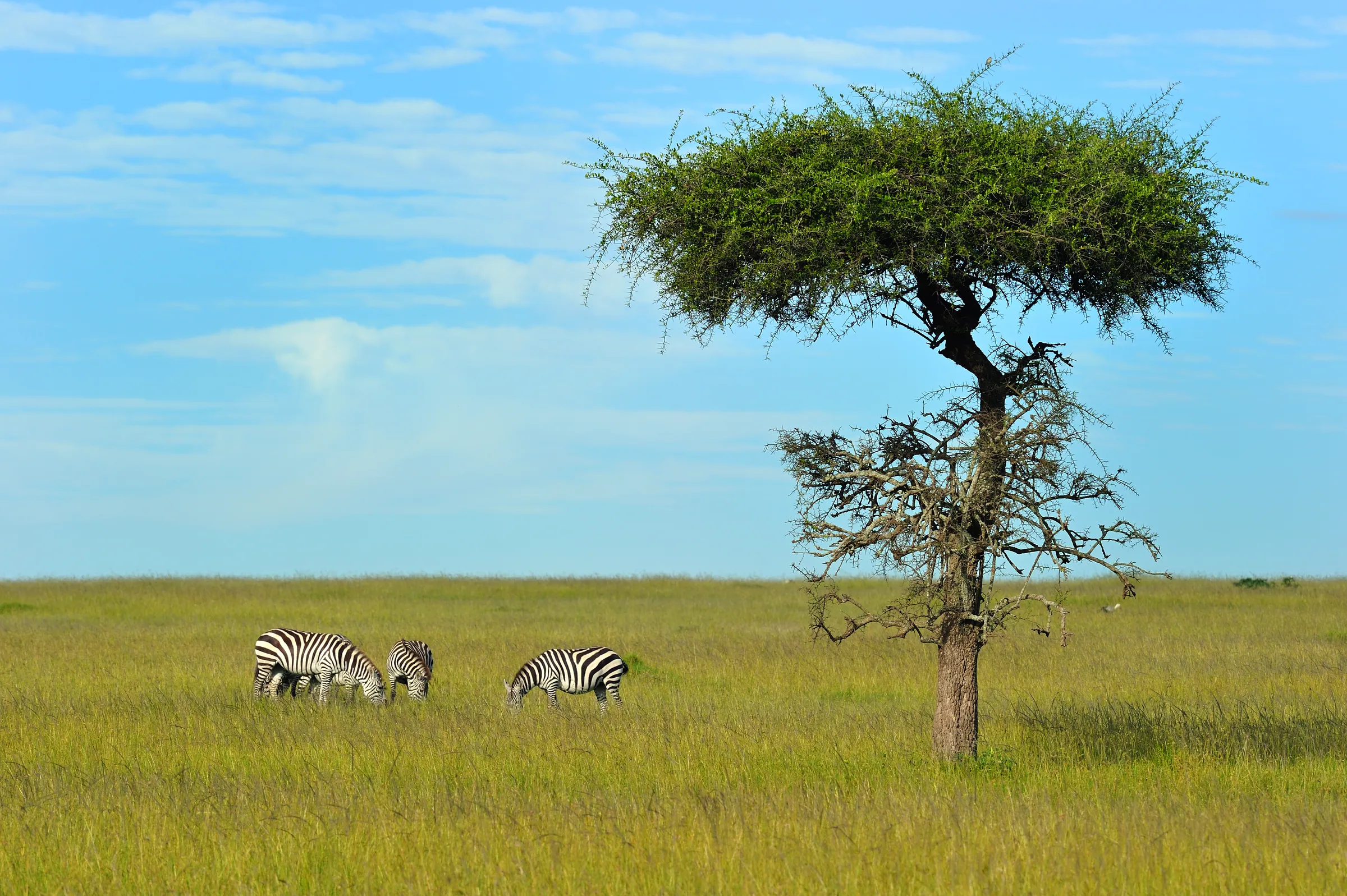
- Maasai Mara: southern ground hornbills in the grassland, with luck and a guide who knows the groups.
- Shimba Hills and Diani: silvery-cheeked, trumpeter and crowned hornbills in the coast forest.
- Arabuko-Sokoke Forest, near Watamu: forest hornbills on guided walks with local bird guides.
- Kakamega Forest: black-and-white-casqued hornbills, loud and easy to hear in the canopy.
How to photograph hornbills
Dry-country hornbills are tame around lodges, which makes them easy subjects. Shoot at eye level from a seated position and wait for the bird to turn its bill side-on, which shows the shape best. For forest hornbills, raise your ISO and watch fruiting fig trees, where they come to feed. Ground hornbills walk at a steady pace, so a vehicle placed ahead of the group and switched off lets them walk past you. Morning light brings out the red face skin.
Conservation status
Most of Kenya's hornbills are listed as Least Concern at the time of writing, but they all need big old trees with cavities for nesting, and the forest species need large forests with plenty of fruiting trees. Logging and charcoal burning take the nest trees. The southern ground hornbill, listed as Vulnerable, also suffers from poisoning, persecution and the loss of grassland. Shimba Hills, Arabuko-Sokoke and Kakamega are protected, and community guides at each forest earn their living from visitors who come to see birds like these.
Trips where you will see them
Any safari that includes Samburu or Tsavo shows you the small hornbills every day, and a Mara stay gives you a chance at the ground hornbill. For the forest hornbills, add a Shimba Hills morning to a Diani beach stay, or Arabuko-Sokoke to a Watamu stay. Our birdwatching guide covers the wider list, and our kingfishers page covers their colorful cousins.