Wildlife. Updated November 2026. 4 min read.
It is your first night at a coast hotel or a bush lodge, and somewhere outside in the dark a baby is crying. It goes on, wailing, then stops. The next evening a waiter points a torch into a tree by the bar, and two huge round eyes shine back. The crier was a greater bushbaby, komba in Kiswahili, and it may visit the same tree every night of your stay.
Bushbabies, or galagos, are small nocturnal primates found across much of Kenya, from coast forests and hotel gardens to the acacia bush of Samburu and Tsavo and the highland forests. You do not usually go looking for them: they find you, at lodges after dark. For better views, a night drive in a private conservancy or a guided night walk at Kakamega or on the coast gives you the best chance. They are active all year, from dusk onward.
Kenya's bushbabies
| Animal | Size | Where | Look for |
|---|---|---|---|
| Greater galagos | Cat-sized, about 1 kg or more | Coast forests and gardens, highland and riverside forest | A big bushy tail, a slow walk and the loud crying call |
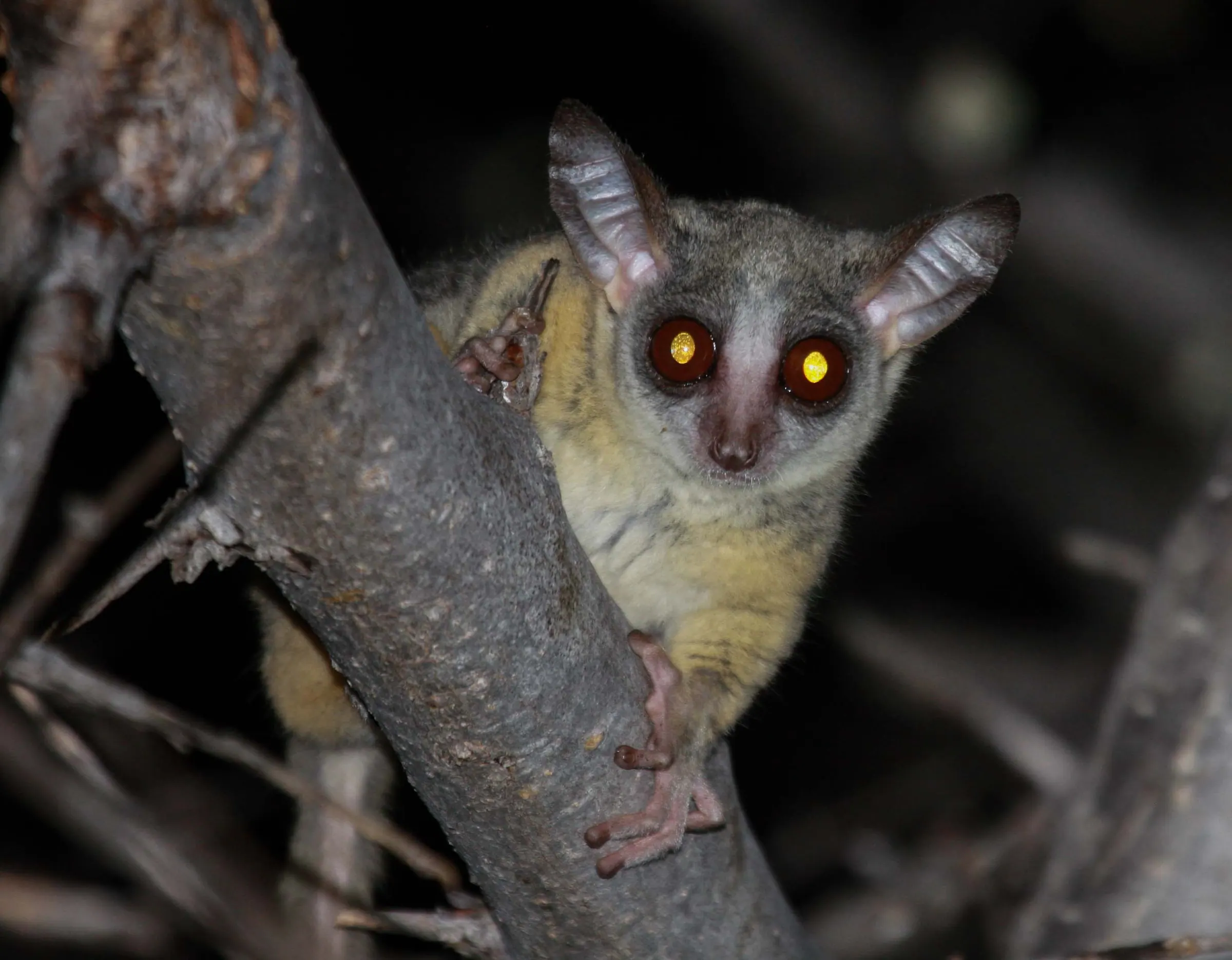
| Northern lesser galago | Palm-sized, about 200 g | Acacia bush and savanna, including Samburu, Tsavo and the Mara | Huge eyes and enormous leaps; licks gum from acacias |
| Dwarf galagos | Smaller still | Coastal forests such as Diani and Arabuko-Sokoke | Fast, tiny, with high-pitched calls |
How a bushbaby lives
Bushbabies sleep through the day in tree holes, tangles of creepers or leaf nests, and come out at dusk to feed. Lesser galagos eat insects, which they snatch out of the air with their hands, and the gum that oozes from acacia trees, especially in the dry season when insects are scarce. Greater galagos eat more fruit, gum and nectar. They mark their routes through the trees by urinating on their hands and feet, which may also improve their grip. Each animal uses a home range of favorite trees, which is why the same bushbaby turns up in the same lodge garden night after night.
Built for the night
A bushbaby's eyes are so large that they barely move in their sockets, so it turns its head instead, almost all the way around. A reflective layer behind the retina makes the eyes shine orange or red in torchlight. Big, thin ears fold away when not in use and swivel to track insects in the dark. Lesser galagos are among the best jumpers of any animal for their size: their long hind legs launch them several meters between branches, and lab measurements have recorded vertical leaps of more than two meters.
Three things most people do not know
First, the name comes from the call: the greater galago's cry really does sound like a human baby, and many guests hear one long before they see one. Second, bushbabies have a toothcomb, a row of forward-pointing lower teeth used to groom fur and scrape gum from bark, and a second, stiff under-tongue that cleans it. Third, they are primates, related to the lemurs of Madagascar and the pottos of Kakamega, which makes them distant cousins of monkeys, apes and us.
Where you are likely to see them
- Diani and the south coast: greater galagos in hotel gardens and the coastal forest, often around the restaurant or bar at night.
- Watamu and Arabuko-Sokoke: greater and dwarf galagos on guided night walks.
- Samburu, Tsavo and Laikipia lodges: lesser galagos in the acacias around camp.
- Mara conservancies, Laikipia and other private land: night drives, which are not allowed in the national reserve or the national parks, often turn up bushbabies.
- Kakamega Forest: night walks for galagos and pottos with local guides.
Feeding: the honest version
Some lodges and hotels put out bananas or other fruit at dusk so that guests can see bushbabies up close, and a few places in Diani, Stilts among them, have long been known for evening bushbaby visits. It is a lovely moment, and it is still feeding wild animals. Fruit and sugar are not their natural diet, and animals at feeding stations fight more, lose their wariness of people and predators, and can pass on disease. Our view: watch them where they feed naturally, enjoy a lodge sighting without touching them or handing over food, and if you stay somewhere that feeds them, treat it as a once-only look rather than a nightly show. Never try to keep or buy a bushbaby; they are wild animals, and taking them is illegal in Kenya.
How to photograph bushbabies
This is hard photography. Use a red-filtered torch or a dim, warm light rather than a bright white beam, and do not hold it on the animal's eyes for long. Raise the ISO, open the aperture wide and shoot short bursts with a stabilized lens at around 1/250 second. Skip the flash: it is harsh on eyes adapted to the dark, and many lodges and conservancies ban it on night drives. Focus on the eyes and accept some grain; a sharp, moody picture beats a bright, blurred one.
Conservation status
Kenya's common bushbabies are listed as Least Concern at the time of writing, though the forest species on the coast depend on forest patches that keep shrinking. Roads, the pet trade and the clearing of old trees are the main local threats. Our primates overview covers bushbabies alongside Kenya's monkeys; this page is for the animal you are most likely to meet after dinner.
Trips where you will see them
A coast stay at Diani or Watamu almost guarantees you will hear them, and a conservancy in the Mara or Laikipia with night drives gives you the best chance of a good view. Ask us to add a guided night walk to a Watamu or Kakamega stay.