Wildlife. Updated November 2026. 8 min read.
Most of our guests leave Kenya without having seen a single wild snake, and a fair number are a little disappointed. Snakes are shy, mostly nocturnal and very good at hiding, and they feel the vibration of a Land Cruiser or a group of walkers long before you would ever spot them. The question we get before the trip, usually from a parent, is the other way round: how worried should we be?
The honest answer is: not very, as long as you follow a few simple habits. Kenya has well over a hundred species of snake, and only a small share of them are dangerous to people. Bites are a real public health problem in rural Kenya, but the people bitten are almost always farmers, herders and children walking at night without shoes or a light, not visitors on a guided safari. Wear closed shoes, carry a flashlight after dark, never put your hands where you cannot see, and let your guide deal with any snake you meet. That covers most of it. The rest of this page explains the snakes that matter, what good camps do, and what to do in the very unlikely event of a bite.
Who actually gets bitten
The World Health Organization estimates that snakebite kills somewhere between 81,000 and 138,000 people a year worldwide and leaves many more with lasting injuries, and it lists snakebite envenoming as a neglected tropical disease. In Kenya, as across Africa and South Asia, the burden falls on rural communities in dry, hot country: people clearing fields by hand, collecting firewood, herding goats or walking home in the dark, often hours from a clinic that stocks antivenom. That is a serious problem, and Kenyan researchers and health workers spend real effort on it. It is also a very different situation from yours. On a safari you spend daylight hours in a vehicle, walk only with trained guides, sleep in a tent or room that is checked and zipped, and are never far from transport.
The snakes that matter
| Snake | Where in Kenya | How it behaves | Why it matters |
|---|---|---|---|
| Puff adder | Almost everywhere below the high mountains, savanna to coast | Fat, slow and beautifully camouflaged; lies still on paths instead of moving off | The cause of many serious bites in Africa, because people step on it |
| Black mamba | Dry bush and savanna, Tsavo, the coast hinterland, the north | Long, fast and shy; gray to olive brown, not black; the name comes from the inside of the mouth | Strongly neurotoxic venom, but it avoids people and bites are rare |
| Green mamba | Coastal forest and thicket, such as Arabuko-Sokoke and Shimba Hills | Slim, bright green and arboreal, rarely seen on the ground | Dangerous venom; very shy |
| Spitting cobras | Savanna, dry country and the coast; several species | Rear up and spray venom toward the eyes when cornered | Venom in the eyes is painful and damaging, but treatable if rinsed fast |
| Egyptian and forest cobras | Dry country, and western forests such as Kakamega | Spread a hood when threatened; usually retreat | Dangerous bite |
| Boomslang | Trees and bushes in savanna and woodland | Large-eyed, shy tree snake that almost never bites unless handled | Slow-acting venom that affects blood clotting |
| Gaboon viper | Western rainforest, such as Kakamega | Heavy, patterned and very well hidden in leaf litter | Rarely met by visitors; very long fangs |
| African rock python | Near rivers, lakes and swamps, from Baringo to Tsavo to the coast | Africa's largest snake; kills by constriction | Not venomous; avoid it and it avoids you |
Most of the snakes guests do see are harmless: sand snakes crossing a track, a house snake near a lodge, an egg-eating snake in a weaver colony, or a rhombic night adder, a small viper whose bite is painful but rarely serious. Many of them are killed by mistake because they are hard to tell apart, which is a good reason to leave identification to your guide.
Where snakes are most common
Snakes like warmth. You are more likely to cross one in hot, low country: the Lake Baringo area in the Rift, Tsavo and the dry bush between Nairobi and the coast, Samburu and the north, and the coastal strip from Diani to Watamu, especially in the forests of Arabuko-Sokoke and Shimba Hills. The western rainforest at Kakamega has its own forest species. On the cold high ground, such as the moorland of Mount Kenya, snakes are scarce. Nairobi has snakes too, mostly in gardens and green belts, though few residents ever meet one. In every region, the rains bring more activity, as prey animals breed and the grass grows tall.
What good camps and guides do
- Keep paths clear and swept, so anything crossing is easy to see.
- Walk guests to and from tents after dark with an escort and a light, mostly because of buffalo and hippos, and snakes are one more reason.
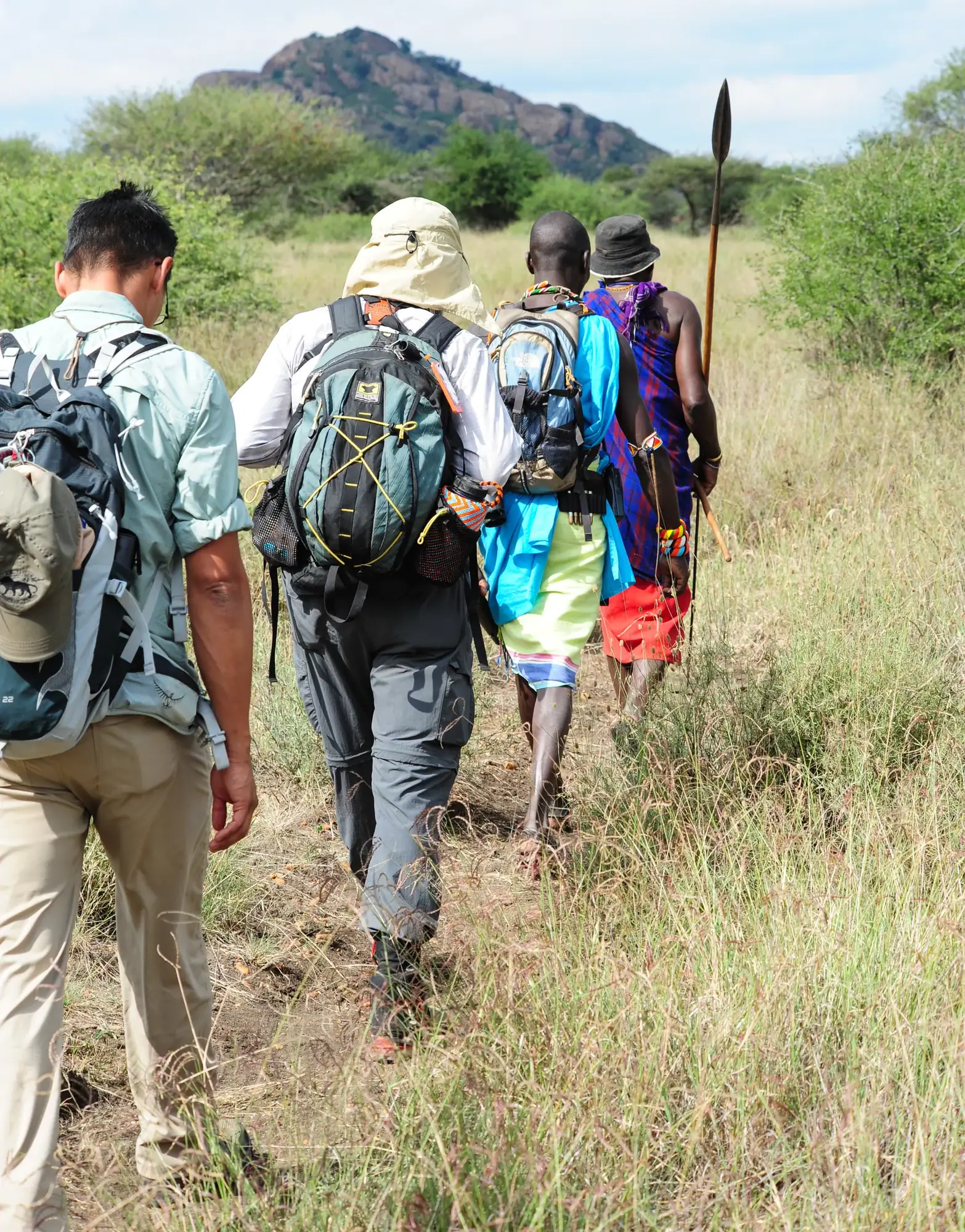
- Brief walkers before a bush walk: single file, eyes on the ground, the guide in front.
- Train staff to move a snake away or call someone who can, rather than kill it.
- Hold a first aid kit and an evacuation plan, and know the route and time to the nearest hospital that stocks antivenom.
Your own habits
- Wear closed shoes and long trousers on walks and around camp after dark. Sandals are fine by the pool in daylight.
- Carry a flashlight or headlamp every time you walk at night, even 30 meters to dinner.
- Never put your hands into holes, rock crevices, wood piles or thick grass, and look before you sit on a log.
- Shake out boots and clothes left outside, and keep your tent zipped.
- If you see a snake, stop, step back slowly and give it room. Almost every snake will leave if it has a way out.
- Never try to catch, kill or photograph a snake from close range. Most bites in the world happen to people handling or attacking snakes.
If someone is bitten
Remember that many bites, even from venomous snakes, deliver little or no venom, and that the right response is calm and fast transport, not heroics. Your guide will take charge; this is what they will do, and what you should do if you are ever on your own.
- Move away from the snake, keep the person calm and lying still, and call for help at once.
- Keep the bitten limb still and at about heart level. Remove rings, watches and tight clothing before swelling starts.
- Get to a hospital as fast as safely possible. Note the time of the bite and any symptoms.
- Do not cut the wound, suck it, apply a tight tourniquet, put ice on it or use traditional remedies. These cause harm and waste time.
- Do not try to catch or kill the snake. A photo taken from a safe distance can help, but it is not needed for treatment.
- For venom in the eyes from a spitting cobra, rinse the eyes with lots of clean water, or any bland liquid if there is no water, for many minutes. Do not rub them. Then see a doctor.
Antivenom, hospitals and evacuation
Antivenom is the only specific treatment for serious envenoming, and Kenya relies largely on imported products. The larger private hospitals in Nairobi and the coast, and some county hospitals, hold stock, while small rural clinics often do not. That is why the practical safety net for visitors is transport: a camp's vehicle or airstrip, and an air evacuation service such as AMREF Flying Doctors. Make sure your travel insurance includes medical evacuation, and read our health page for the hospitals and cover we recommend. On our trips, your guide and camp know the evacuation route before you arrive.
Where to see snakes safely
If you or your children would like to see Kenya's snakes up close, go where experts keep them. Bio-Ken Snake Farm in Watamu, founded by the late herpetologist James Ashe, combines a small public collection with research, snake rescue from homes and hotels, and work on snakebite treatment. A large spitting cobra found on the Kenyan coast, Ashe's spitting cobra, was described as a new species in 2007 and named after him. Guided visits explain how to tell harmless from dangerous snakes, which is the most useful hour of snake education you can get. In Nairobi, the Snake Park at the Nairobi National Museum, run by National Museums of Kenya, has living snakes, lizards and crocodiles and pairs easily with a museum morning.
Three things most people do not know
First, the black mamba is not black. It is gray, olive or brown, and the name comes from the inky lining of its mouth, shown when it gapes in threat. Second, the snake that worries Kenyan doctors most is not the famous mamba but the humble puff adder, because it sits still on paths and people step on it. Third, snakes have no external ears and cannot hear most airborne sound, but they feel vibration through the ground very well, which is why walking with a firm, steady step is a good habit on paths.
Photographing snakes
If your guide finds a snake on a drive, shoot from the vehicle with a long lens and let the snake go about its business. A 300 to 400 mm lens gives a frame-filling head shot from a safe distance. Focus on the eye, keep the background simple and never ask anyone to move or pose a snake for you.
Snakes and conservation
Snakes are killed on sight across much of Kenya, harmless ones included, and roads and land clearing take many more. They do useful work: snakes eat rats and mice that damage crops and stored grain. Education is the best tool, and projects that teach communities to recognize the few dangerous species, and that respond to snakes in homes by moving rather than killing them, help people and snakes at once. Most Kenyan snakes are not threatened, but a few forest and coastal species have small ranges that depend on forests surviving.
Snakes are part of a wild country, and seeing one from a safe distance is a privilege. Our guides are trained in first aid and bush safety, and every trip we plan has an evacuation plan behind it. If snakes are your worry, tell us: we will explain exactly what the camps on your route do.