Wildlife. Updated November 2026. 4 min read.
Our guides in Samburu have a habit of stopping beside a thorn bush that looks completely empty. Give it a minute. A slim head on a very long neck rises above the leaves, then the whole animal comes into view, standing upright on its hind legs, front hooves resting on a branch, picking leaves from between the thorns. That is the gerenuk, swala twiga in Kiswahili, the giraffe gazelle, and the first time you see one stand up most people laugh out loud.
Gerenuk live in the dry bush of northern and eastern Kenya. The best places are Samburu, Buffalo Springs and Shaba reserves, Meru National Park, Tsavo East and Tsavo West, and the northern Laikipia conservancies. They are resident all year and easiest to see feeding in the early morning and late afternoon. The gerenuk is one of the Samburu Special Five, and our page on the five covers the northern set; here we go deeper into the animal itself.
Where to see gerenuk
| Place | Why go | Good to know |
|---|---|---|
| Samburu and Buffalo Springs | Gerenuk in the acacia and commiphora bush back from the Ewaso Ng'iro river | The classic place, with all of the Special Five nearby |
| Shaba National Reserve | Quiet bush with few vehicles | Good for a gerenuk sighting all to yourselves |
| Meru National Park | Drier bush in the north and east of the park | Combine with rhinos in the sanctuary |
| Tsavo East | Gerenuk on the red earth, often near the main tracks | An easy add to a coast trip |
| Tsavo West | Dry bush away from the springs and lava | Thicker cover, so sightings take patience |
| Northern Laikipia | Conservancies such as Loisaba, with walks and camel treks | On foot, you see how they freeze and slip away |
What you are looking at
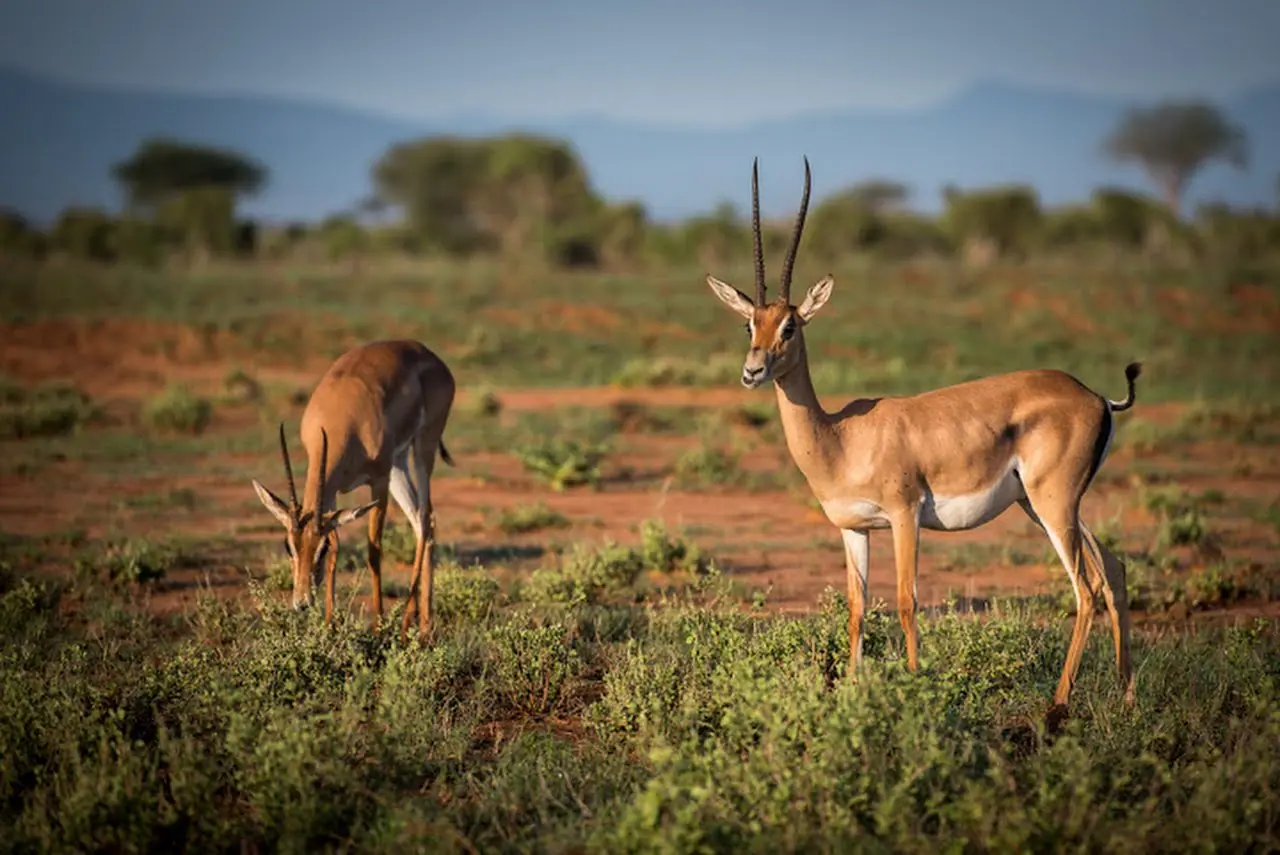
A gerenuk is slender and long-legged, about 0.9 to 1 meter at the shoulder and somewhere around 30 to 50 kilograms, with males the bigger. The back is a reddish-brown saddle over paler, sandy sides, the belly is white, and a white ring circles each large eye. The head is small and wedge-shaped, the ears big. Only males have horns: short, thick and heavily ringed, sweeping back and then hooking forward at the tips. Females are hornless, which is the easiest way to sex a group.
How it stands up to eat
The gerenuk is a browser, eating leaves, shoots, flowers and fruit rather than grass. Standing on its hind legs lets it reach about 2 meters, above the dik-dik and impala and below the giraffe, so it has a layer of the bush almost to itself. Its lower spine and hips are built to hold that upright pose for long stretches, and its narrow muzzle and mobile lips pick single leaves from between acacia thorns. It will hook a higher branch with a foreleg and pull it down. Because it gets most of its water from leaves, a gerenuk can live without drinking, and in much of its range it rarely sees standing water at all.
Behavior to watch for
- Small groups: usually a few females with their young; adult males live alone or hold a territory with females moving through it.
- Scent marking: males rub a gland in front of each eye on twigs, leaving a dark, sticky mark that defines their ground.
- Freezing: when alarmed, a gerenuk stands perfectly still behind a bush, then slips away with its neck stretched forward and its head low.
- Hidden calves: newborns lie hidden in the bush for their first weeks while the mother feeds nearby.
- Feeding hours: they browse early and late and rest in shade through the heat of the day.
Three things most people do not know
First, the English name is borrowed from Somali and is usually translated as giraffe-necked, a close match for the Kiswahili swala twiga. Second, although it looks like a gazelle and belongs to the same broad family group, the gerenuk sits in a genus of its own. Third, a standing gerenuk is said to shuffle a step or two on its hind legs to reach the next branch, so if you see one stand, keep watching.
How to photograph gerenuk
The shot everyone wants is the standing pose. When your guide finds a gerenuk browsing, ask for the engine off, pre-focus on the head and wait; it may drop and rise several times. Shoot side-on to show the length of the neck, with a zoom around 200 to 400 mm, and leave space above the head in the frame. A gerenuk on Tsavo's red earth, or against the pale trunks of Samburu's acacias in low sun, makes a far better picture than one against a gray midday sky. Keep voices down: gerenuk are shy and leave at the first fuss.
Conservation status
The IUCN lists the gerenuk as Near Threatened at the time of writing, with numbers falling across Kenya, Ethiopia, Somalia and northern Tanzania. Its problem is habitat: the thorn bush it lives on is cleared for farms and cut for charcoal, and long droughts and growing livestock herds take their share. Because gerenuk need so little water, they can live in country too dry for most wildlife, and that makes the community conservancies of the north, along with Samburu, Meru and Tsavo, especially important for them.
Trips where you will see gerenuk
A northern safari of two or three nights in Samburu or Buffalo Springs almost always turns up gerenuk, though no wild sighting can be promised, and Meru or Laikipia adds more chances on the same route. On a coast trip, Tsavo East is the easy option between Nairobi and Mombasa or Diani. Our oryx page covers the other dry-country antelope you will meet in the same places.