Wildlife. Updated November 2026. 5 min read.
Up close, a wildebeest is a strange animal: the front end of a buffalo, the beard of an old man, the legs of an antelope and a voice like a frog with a cold. Put more than a million of them together and you get the Great Migration, the event that brings many people to Kenya in the first place. Our guides like to point out that, for all the fame, few visitors ever stop to watch a single wildebeest. This page is about the animal. For the timetable of where the herds are each month, see our Great Migration guide.
In Kenya, you see the migratory herds in the Maasai Mara and its conservancies from about July to October in most years. But wildebeest live in Kenya all year: resident herds on the Loita plains and in the eastern Mara, small herds in Amboseli and a remnant population in Nairobi National Park. A December or March safari in the Mara still shows you wildebeest, just thousands instead of a million.
What a wildebeest is
The wildebeest of East Africa is the white-bearded wildebeest, a form of the blue wildebeest. It is a large antelope, related to hartebeest and topi, with a heavy front, a sloping back and both sexes carrying curved horns. Bulls weigh roughly 200 to 270 kilograms; cows are a little smaller. The name gnu is thought to come from a Khoikhoi word imitating the animal's nasal call, and when a big herd settles at dusk the grunting chorus carries across the plain all night.
Wildebeest in Kenya at a glance
| Population | Where | When you see them |
|---|---|---|
| Serengeti-Mara migratory herds | Northern Serengeti in Tanzania and the Maasai Mara | In the Mara usually about July to October; estimates put the herd at over a million |
| Loita resident herds | Loita plains and the eastern Mara conservancies | Much of the year, moving with the rains; far fewer than in the 1970s |
| Amboseli herds | The open plains and swamps of Amboseli | All year, in small numbers |
| Athi-Kaputiei and Nairobi NP | Nairobi National Park and the plains to its south | A small, much reduced population, mostly in the dry season |
A year in a wildebeest's life
The migratory herds calve on the short-grass plains of the southern Serengeti, roughly late January to March, and most calves are born within a few weeks of each other. So many calves at once overwhelm the predators, and a calf can stand within minutes and run with the herd within hours. The rut follows as the herds move north and west in the long rains, with bulls holding small temporary territories, bellowing and chasing cows. By the time the herds reach the Mara, they are following the rain-fed grass. Wildebeest prefer short, fresh grass and need to drink most days, which is why the herds move: they are following rain, grass and water, not a calendar.
The Loita herds have their own pattern, calving in the Kenyan plains rather than the Serengeti, so you can see young wildebeest in Kenya early in the year too. That resident population has fallen sharply since the 1970s, as fences, wheat farms and settlements have spread across its range.
Behavior to watch for
- The rocking canter: wildebeest run with a bouncing, rocking-horse gait, and they buck and toss their heads for no obvious reason, which is why guides call them the clowns of the plains.
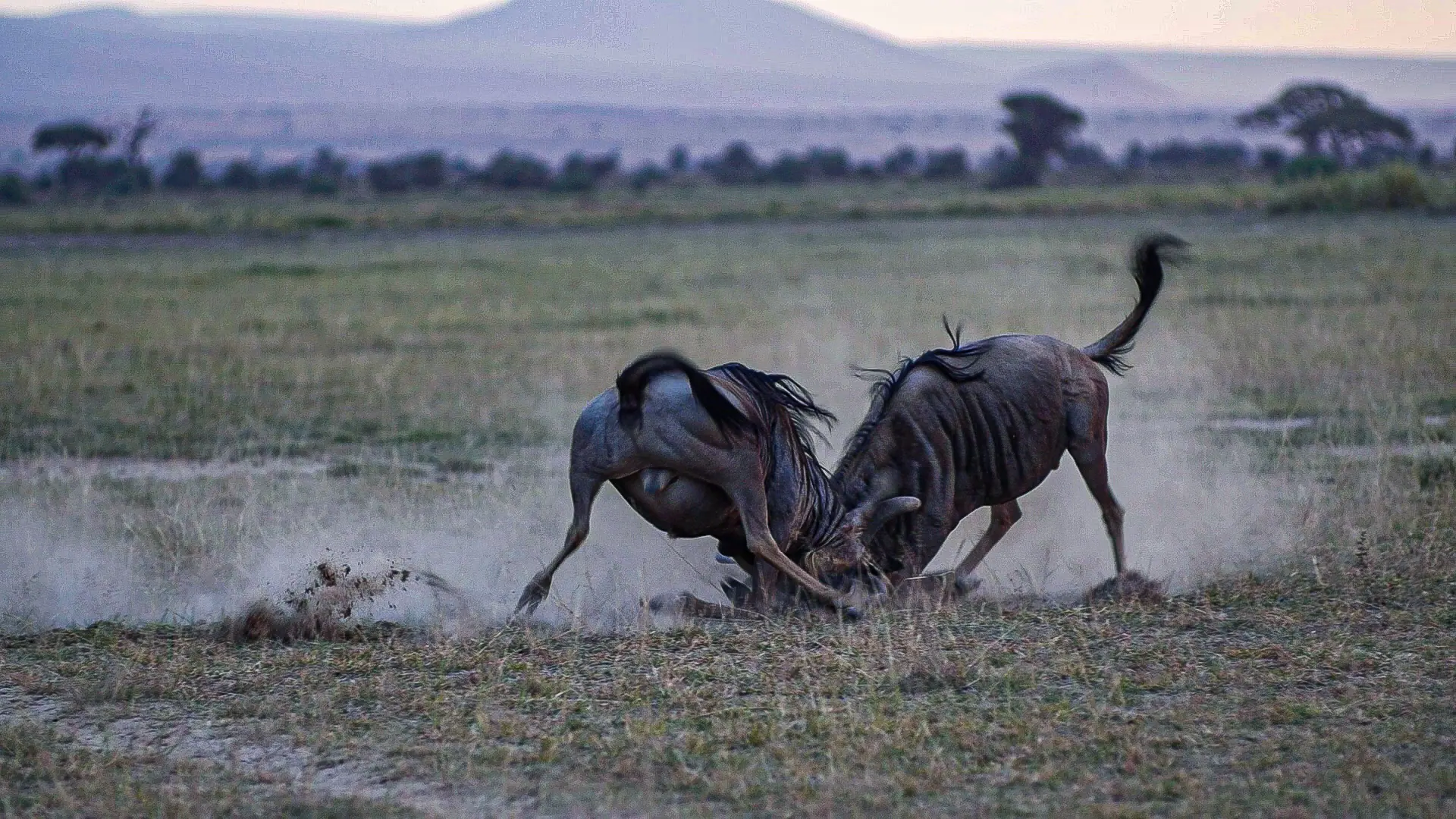
- Bulls on territory: a bull paws the ground, rubs his face on the grass, drops to his knees and faces a rival forehead to forehead. That is sparring, and it is all over in seconds.
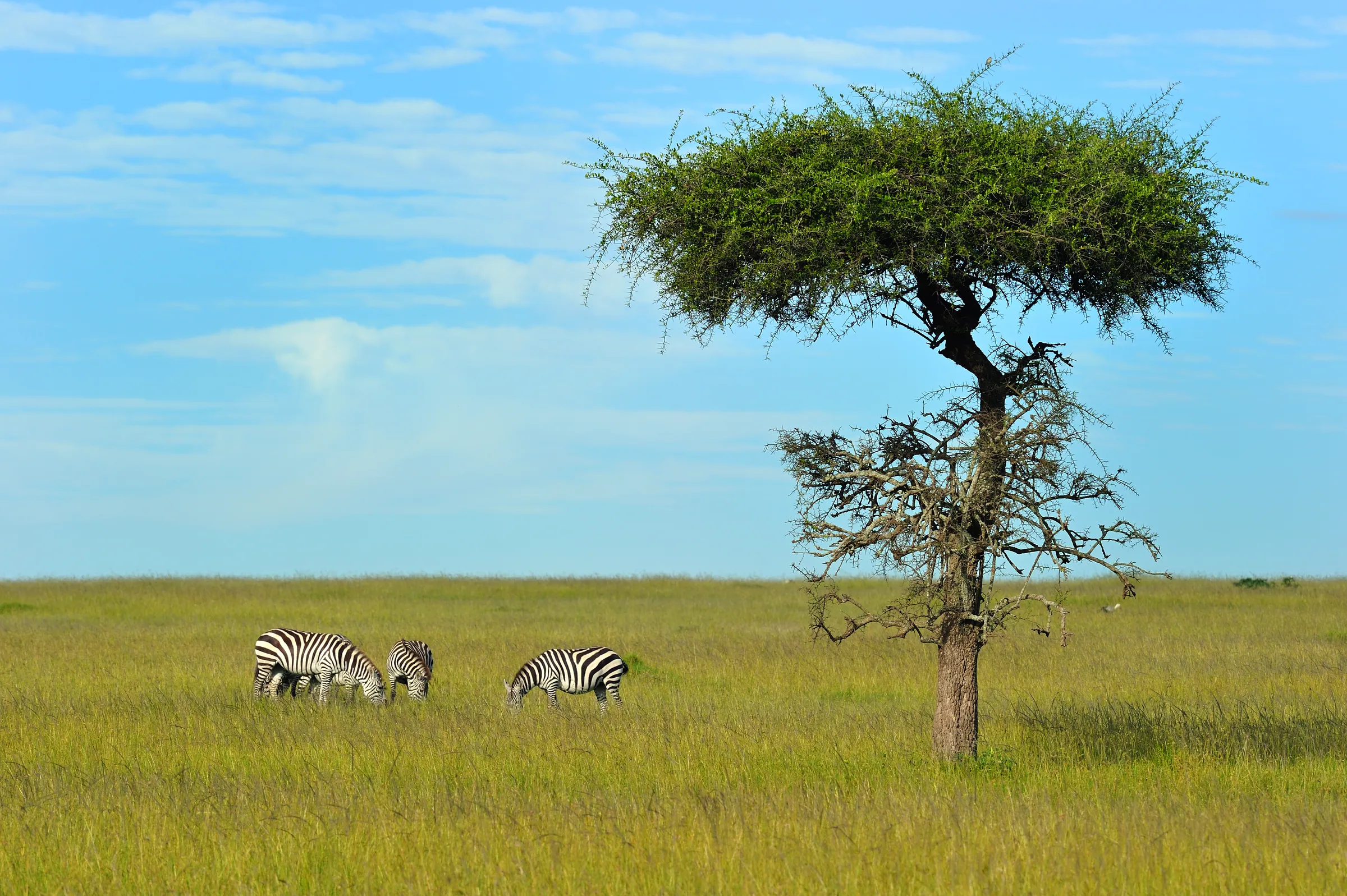
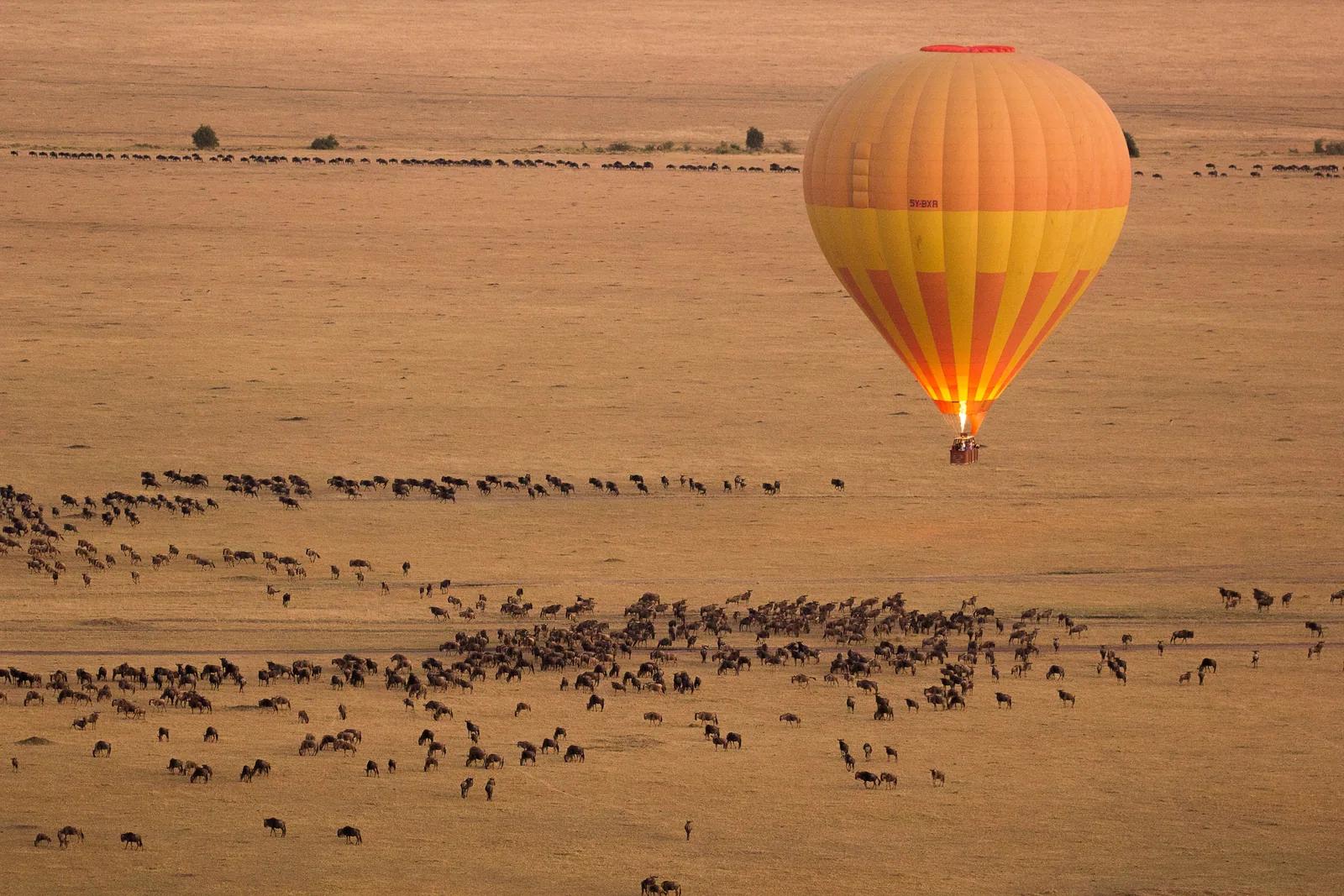
- Single file: on the move, herds walk in long lines along the same paths, often with zebras nearby. Zebras crop the taller grass and wildebeest follow on the shorter growth.
- Mothers and calves: a calf stays at its mother's side, and a lost calf will run toward any moving thing, including vehicles.
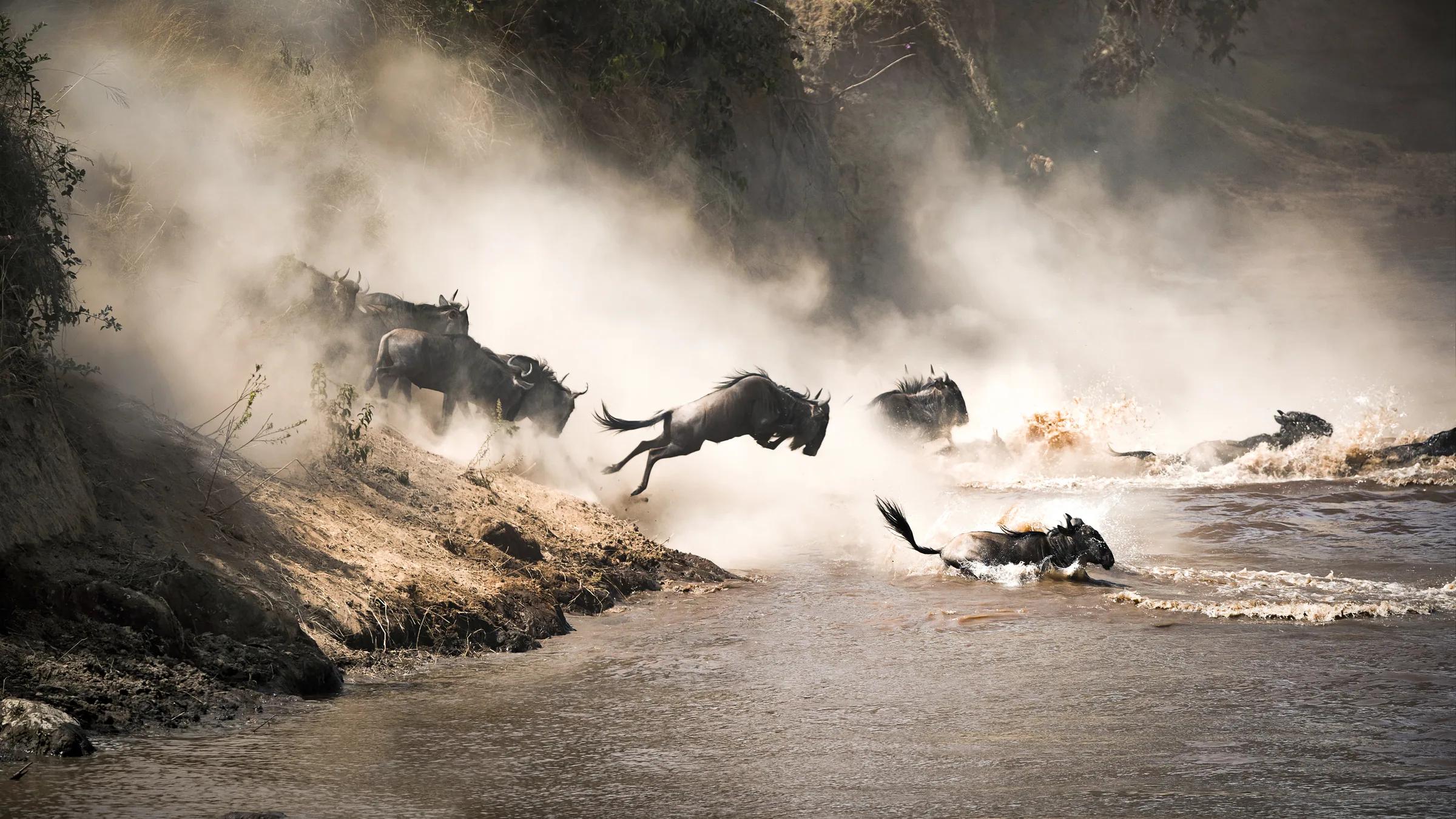
- At the river: herds gather at the bank, hesitate, back off and gather again. Once one animal jumps, the rest follow in a rush. Our river crossings page explains where and why.
Three things most people do not know
- Nobody leads the migration. The herds move as a mass of individual decisions, and a crossing can start with one nervous animal at the front.
- Wildebeest shaped the Serengeti-Mara landscape. When their numbers recovered after rinderpest was controlled in the 1960s, heavier grazing meant less dry grass to burn, and trees came back in many areas.
- Researchers estimate that thousands of wildebeest drown in the Mara River in an average year, and the carcasses feed the river for weeks, from fish to vultures.
How to photograph wildebeest
The herds are about scale and movement. A wide lens from a low angle makes a line of wildebeest run to the horizon. A slow shutter, around 1/30 of a second, panned with a running herd, blurs the legs and keeps the heads sharp. For sparring bulls and crossings use 1/2000 of a second and a 300 to 400 mm lens, and let the dust do the work in backlight. From a balloon at dawn, shoot straight down on the lines of animals.
Watching the herds well
- At crossings, park well back from the river and leave the herds a clear path to the water.
- Keep quiet; noise and movement on the bank can stop a crossing or turn it into a stampede.
- Follow reserve and conservancy rules on vehicle numbers and distance.
- Never drive between a mother and her calf.
Conservation status
The IUCN lists the blue wildebeest, including the white-bearded form, as Least Concern. The Serengeti-Mara herds are healthy for now, but they depend on open land across two countries and on a flowing Mara River, which in turn depends on the Mau Forest. Kenya's resident herds are the warning sign: on the Loita plains and around Nairobi National Park, fences and farms have cut migration routes and numbers have collapsed. The Mara conservancies, where Maasai landowners lease land for wildlife, are a large part of why the herds still have room in Kenya.