Planning a safari. Updated November 2026. 6 min read.
Look around any safari airstrip in Kenya and many of the travelers are past 55. The camps know it, and the good ones plan for it. Here is how to build a trip that is easy on knees, backs and early mornings, without missing anything.
The short answer: five choices do most of the work. Fly between parks instead of spending six hours on bumpy roads. Choose lodges with level paths and walk-in showers, or ask hard questions about steps and distances at tented camps. Slow the pace to two parks in a week, three nights each, with one main game drive a day. Take a private vehicle so you can stop, stretch and come back when you have had enough. And sleep in Nairobi on arrival and before you fly home. Add a travel clinic visit that takes your medications into account and insurance with medical evacuation cover, and the rest is enjoying it.
The five choices that make it easy
| Choice | The easy option | The harder option |
|---|---|---|
| Getting between parks | Light aircraft from Wilson Airport: about 45 minutes to the Mara | Five to six hours by road, the last stretch rough |
| Where you sleep | Lodges with level paths, golf-cart transfers and walk-in showers | Tented camps with steps, raised decks and long walkways |
| Pace | Two parks in a week, three nights each, one main drive a day | A new camp every night, dawn and afternoon drives every day |
| Vehicle | A private vehicle: stop, stretch, return when you choose | A shared vehicle on someone else's schedule |
| Nairobi nights | A night to recover on arrival and a calm last night | Landing and driving straight to the park |
Flying is the biggest single change. A road safari to the Mara takes most of a day each way, and the last part shakes every joint in the body. A light aircraft from Wilson takes about 45 minutes, and the camp vehicle meets you at the airstrip. Our Wilson Airport guide explains how the flights work, including the 15 kg soft-bag limit. Most travelers manage the steps into the small aircraft easily, and crews are used to helping.
Lodges, tents and steps: what to ask
Safari accommodation ranges from hotel-style lodges with paved paths to tented camps spread along a river, where the furthest tent can be a long walk on uneven ground from the dining area. Neither is better; one will suit you. Ask before you book, or let us ask:
- How far is the furthest room or tent from the dining area, and is the path level or stepped?
- How many steps up to the tent or room? Are there handrails?
- Is there a walk-in shower, or a step into a bath or a raised shower tray?
- Can we have a room close to the main area?
- Is there a golf cart or a vehicle for transfers within the camp?
- Who walks us to the room after dark, and how is the path lit?
- Is there electricity at night, for a CPAP machine or other medical equipment?
Pace: one good drive a day
You do not need two game drives a day to see a great deal. Many older travelers take one long morning drive, rest through the heat, and go out again only when they feel like it. Afternoon drives usually start around 4pm, so there is time for lunch and a proper rest. If you want to catch the early light without the early breakfast, lodges will pack one for you to eat in the vehicle. Three nights in each park gives you two full days without packing, which is where a trip starts to feel like a holiday.
Vehicles: getting in and out
Safari Land Cruisers sit high off the ground. Ask for one with a step and a grab handle, and ask for the seat nearest the door. In a private vehicle you can stop to stretch whenever you need to, and your guide will drive the smoother tracks if you ask. You do not have to stand to see through the roof; windows give a good view seated. At fly-in camps the vehicles are usually open-sided and cold at dawn, so bring a warm layer and a blanket is often provided. Our safari vehicles guide compares the types, and private versus shared explains the cost.
Altitude and heat
| Place | Altitude | What to expect |
|---|---|---|
| Nairobi | About 1,795 m (5,900 ft) | Mild, cool evenings; you may notice the altitude on stairs for a day or two |
| Maasai Mara | About 1,500 m (4,900 ft) | Warm days, cold early mornings |
| Laikipia | Up to about 2,000 m (6,600 ft) | Cool, dry, pleasant days; cold nights |
| Samburu | Lower, hot and dry | Hot middays; rest in the shade |
| The coast | Sea level | Hot and humid; plan for the heat |
These heights are mild, but they can be noticeable for people with heart or lung conditions, so mention your itinerary to your doctor. Drink more water than you think you need, especially in Samburu and on the coast. Our altitude page has more.
Health, medications and medical care
- See a travel clinic early, about eight weeks before you fly, and bring your list of medications. Malaria tablets and vaccines need to be chosen around what you already take
- Bring a month's supply of prescriptions, more than the trip needs, in the original packaging, with a letter from your doctor listing them
- Keep medications in your hand luggage, never in a checked bag
- Nairobi has good private hospitals, including the Aga Khan University Hospital, Nairobi Hospital and Karen Hospital
- From the parks, serious cases are flown to Nairobi. AMREF Flying Doctors sells an evacuation membership to visitors; check the current terms on its site
- Since October 6, 2026, visitors must also buy Kenya's inbound travel health insurance through eCitizen. It does not replace your own travel insurance
Our vaccines and malaria pages explain the medical side in detail, and CDC's Kenya page is the official reference.
Insurance: read the age bands
Travel insurance is required on all our trips, and for older travelers the details matter. Many policies are priced by age band, and cover for pre-existing conditions often depends on buying the policy within a set time after you book, so check the terms the week you commit. Make sure medical evacuation covers both legs: from the park to Nairobi, and from Nairobi home if a doctor advises it.
Mobility, wheelchairs and the balloon
- In Nairobi, UberASSIST offers vehicles for wheelchair users
- Some lodges have step-free rooms and adapted bathrooms; our accessible travel page explains how we plan around mobility needs
- Bush airstrips and camp paths are uneven; a walking stick helps
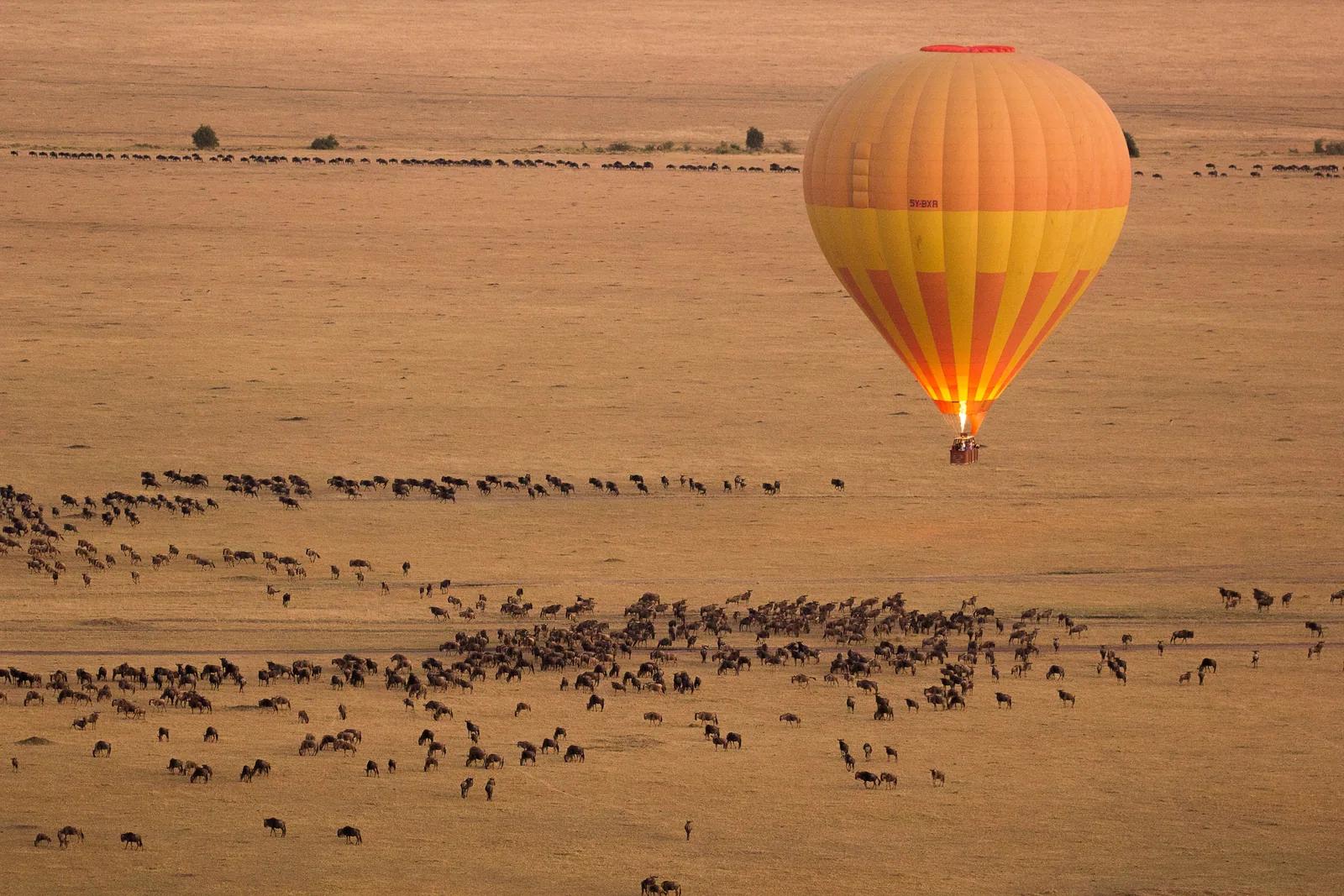
- A balloon flight means climbing into a waist-high basket and holding a crouched landing position, and the basket sometimes tips onto its side on landing. Talk to the operator honestly about knees and backs. Watching the launch from the ground is a fine morning too
- Walking safaris are optional; a gentle guided walk around camp is often possible
A gentle 8-day itinerary
| Day | The plan | Night |
|---|---|---|
| 1 | Land in Nairobi, met at the airport, straight to the hotel to rest | Nairobi |
| 2 | A short morning flight from Wilson to the Mara, lunch, an afternoon drive from about 4pm | Maasai Mara |
| 3 | One long morning drive with a packed breakfast, the afternoon free | Maasai Mara |
| 4 | A balloon for those who want it, a late start for those who do not | Maasai Mara |
| 5 | A light-aircraft connection to Laikipia, sometimes with a stop, and an easy afternoon | Laikipia |
| 6 | Rhinos and the northern species, cooler air, a long lunch | Laikipia |
| 7 | A slow morning, a final drive at sunset | Laikipia |
| 8 | Fly to Nairobi, a day room, dinner, the evening flight home | On the plane |
For costs, see our Kenya safari cost guide; for a longer version of the same pace, our 10-day itinerary. Traveling solo? Our dated group departures give you company on the drives, and the single supplement on rooms is often 20 to 30 percent. Bringing children or grandchildren along is a different trip: see multigenerational safaris.