
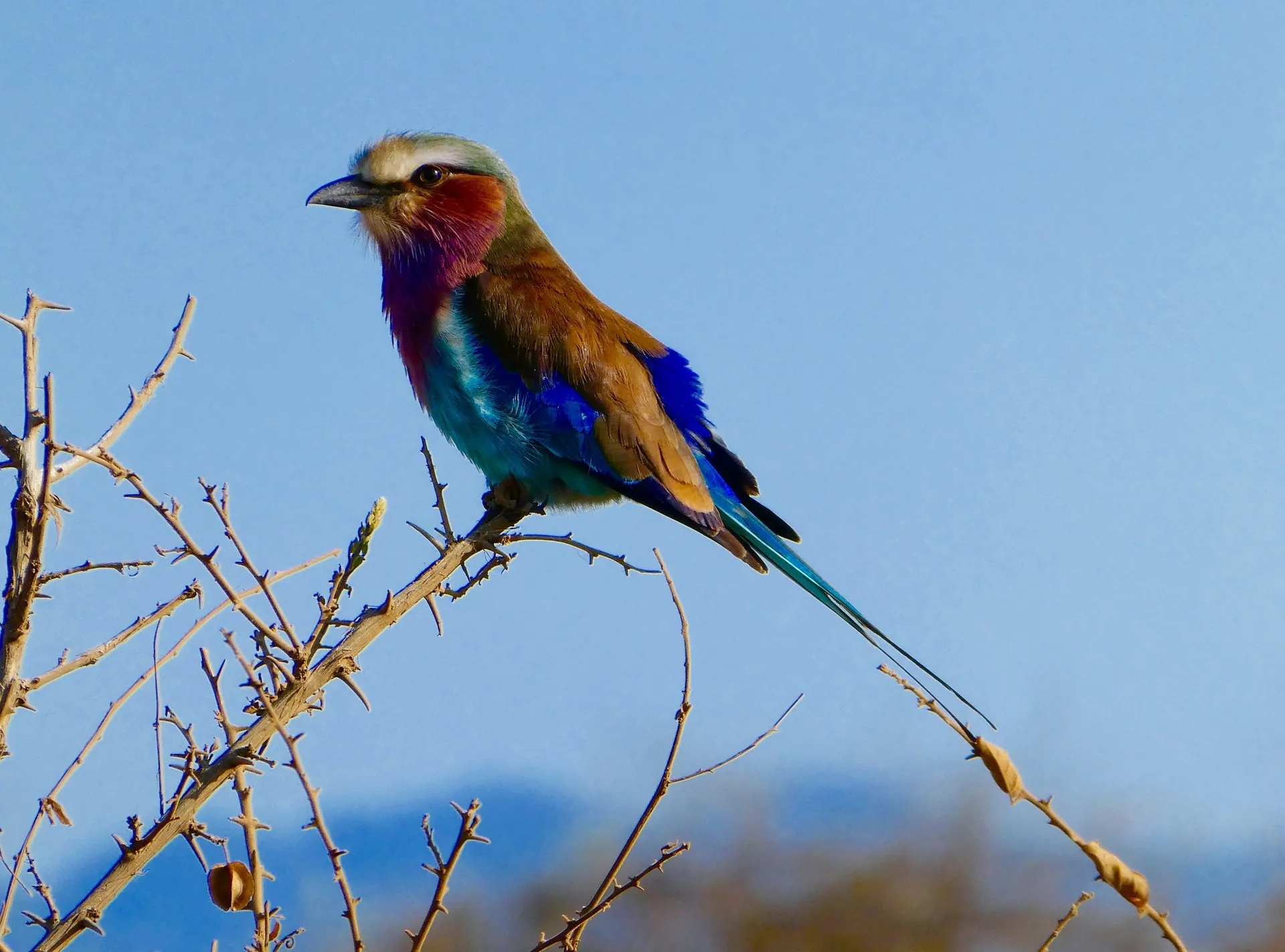
Wildlife. Updated November 2026. 3 min read.
A dark babbler with a scaly, patchy white pattern and a red eye. Hinde's babbler (Turdoides hindei) is 23 cm long and vulnerable on the IUCN Red List; it lives nowhere but Kenya and its immediate neighbours. Endemic to central Kenya's Kikuyu and Embu valleys; the Kianyaga valleys near Embu are the classic site.
Where to see Hinde's babbler
- Mount Kenya: Africa's second-highest mountain: Point Lenana for trekkers, Batian and Nelion for climbers, and forest and moorland for everyone else.
- Nairobi: The safari capital: a national park inside the city limits, elephant orphans, giraffes and the best food and nightlife in East Africa.
- Ol Donyo Sabuk: Buffalo, colobus and the McMillan graves on a forested mountain near Thika, with Fourteen Falls next door.
Groups move through river-valley thickets in central Kenya, calling harshly. It takes a little targeting: tell your guide it is on your list; the best months are Jan, Feb, Aug, Sep.
How to identify it
A dark babbler with a scaly, patchy white pattern and a red eye. Size: about 23 cm, thrush-sized. Family: babblers. Groups move through river-valley thickets in central Kenya, calling harshly.
Status and conservation
Hinde's babbler is vulnerable on the IUCN Red List. Habitat loss is the main pressure; the parks, forests and conservancies you visit are where the populations hold. As a Kenyan endemic or near-endemic it is one of the birds that bring birders to the country specifically.
On a Kenya Experience trip
Our guides carry binoculars and the East African field guide in every vehicle, and our birding itineraries put a specialist bird guide in the front seat. For Hinde's babbler we would start at Mount Kenya and Nairobi. Tell us the species on your list and we build the days around them.