
Towns and places. Updated November 2026. 3 min read.
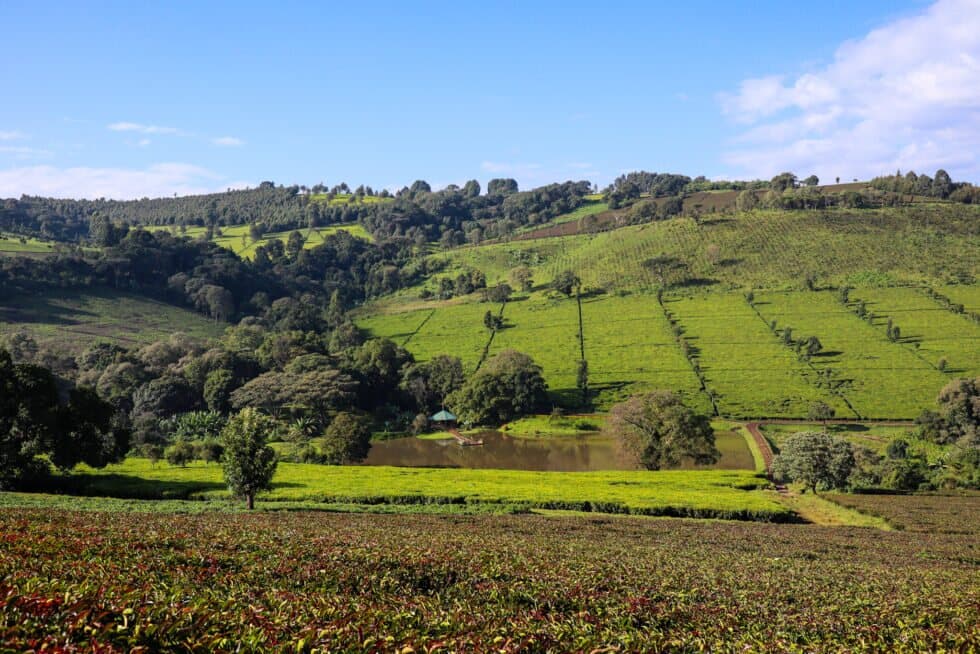
Kericho is Kenya's best-known tea region, and tea is one of the country's top exports. The town also has Africa's largest Sikh Gurdwara. Kericho sits about 2,000 metres up on the edge of the Mau Forest. Rain falls all year, keeping its tea estates bright green. It is the heartland of the Kipsigis, the largest Kalenjin group.
Here are the 7 things to do in Kericho County that we would send a visitor to, in rough order of how often our travelers ask for them, followed by how to fit them into a trip.
1. Tea estates and factories
Walk the tea rows and see how leaf becomes cup. This is the county's headline stop and the one to anchor a day around.
2. Chagaik Arboretum
Indigenous trees and bamboo among the tea fields. Pairs well with Tagabi Monkey Sanctuary, which is usually done the same day.
3. Tagabi Monkey Sanctuary
A nature trail where vervet monkeys roam freely. Pairs well with Fort Ternan Museum, which is usually done the same day.
4. Fort Ternan Museum
The site where fossils of the ancient ape Kenyapithecus were found. Pairs well with Kapkatet Museum, which is usually done the same day.
5. Kapkatet Museum
Kipsigis artefacts and heritage. Pairs well with Chebulu Conservancy, which is usually done the same day.
6. Chebulu Conservancy
Community rainforest with monkeys, rock hikes and camping. Pairs well with Mau Forest, which is usually done the same day.
7. Mau Forest
East Africa's largest native montane forest. A good last stop on the way out of the county.
Culture and daily life in Kericho
Kipsigis song traditions helped give rise to Kalenjin pop music. The signature dish is mursik, milk fermented in a gourd, eaten with finger-millet ugali. The area is also famous for distance runners.
Tea is king, grown on large estates and smallholdings, followed by coffee, sugarcane, maize and dairy.
A day in Kericho
| Time | Plan |
|---|---|
| Early morning | Tea estates and factories: walk the tea rows and see how leaf becomes cup. Go first, before the heat and the crowds. |
| Late morning | Chagaik Arboretum: indigenous trees and bamboo among the tea fields. |
| Lunch | Nyama choma from a roadside butchery in Narok or Kajiado, at a local restaurant in Kericho or the nearest town. |
| Afternoon | Tagabi Monkey Sanctuary: a nature trail where vervet monkeys roam freely. |
| Late afternoon | Fort Ternan Museum: the site where fossils of the ancient ape Kenyapithecus were found. |
| Evening | Kipsigis song traditions helped give rise to Kalenjin pop music. Ask your host where the music or the choma is that night. |
Nearby, and how to fit Kericho into a trip
Kericho is about 260 km from Nairobi (5 hours by road; see the getting-there page). The attractions above fill two full days comfortably, or one long one if you pick the first three. The best months are kericho is green all year, but december–february and june–september are drier for estate walks; the when-to-go page has the month-by-month weather.
- Kericho, in the county: Tea country: rolling green estates, factory tours and afternoon rain like clockwork.
- Bomet County, about 60 km away: Bomet holds the headwaters of the Mara River, which keeps the Maasai Mara alive.
- Nakuru County, about 110 km away: Olkaria opened in 1981 as Africa's first geothermal station.
- Narok County, about 130 km away: The Maasai Mara is Kenya's most famous safari destination and the stage for the Great Migration.
- Laikipia County, about 260 km away: Private ranches and community conservancies cover more than half the county and support Big Five wildlife outside national parks.
Who it suits
Agritourism groups, students and anyone curious about where Kenya's exports come from. Kericho is Kenya's best-known tea region, and tea is one of the country's top exports. The town also has Africa's largest Sikh Gurdwara.